(E-E).E.v.g.e.n.i.j ..K.o.z.l.o.v Berlin |
|
home // E-E // biographie // art // eros // Leningrad 80s // Valentin Kozlov // 2 x 3m // events // lageplan // kontakt /
 / |
(E-E).E.v.g.e.n.i.j ..K.o.z.l.o.v Berlin |
|
home // E-E // biographie // art // eros // Leningrad 80s // Valentin Kozlov // 2 x 3m // events // lageplan // kontakt /
/ |
(E-E) Evgenij Kozlov: Leningrad 80s • No.122
(E-E) Evgenij Kozlov
|
||||||||||||||||||||||||||||||||||||
|
|
||||||||||||||||||||||||||||||||||||
|
St. Petersburg Archive and Library of Independent Art, Pushkin street 10, St. Petersburg
Петербургский архив и библиотека независимого искусства, Пушкинская 10, Ст. Петербург 29 July 2000 |
||||||||||||||||||||||||||||||||||||
|
Curated by: Andrey Khlobystin, artist and director of the Petersburg Archive and Library of Independent Art Evgenij Kozlov, artist and collector (Collection "2x3m") Hannelore Fobo, curator and independent researcher |
||||||||||||||||||||||||||||||||||||
 |
||||||||||||||||||||||||||||||||||||
|
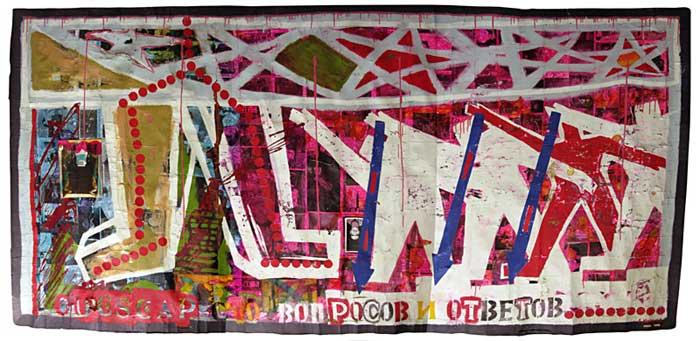
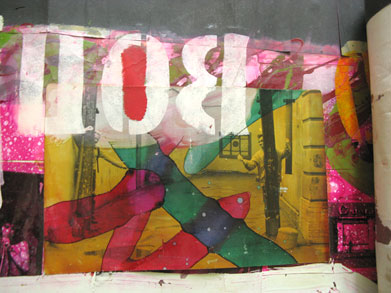
Hannelore Fobo: E-E Kozlov’s photo archive as a primary source for scientific research (2020, revised 2025) E-E. Cult Heroes of the 1980s was the first exhibition dedicated to (E-E) Evgenij Kozlov‘s photographs documenting the Leningrad art and music scene of the 1980s. Yet it is essential to understand that Kozlov's pictures have become archival documents only in retrospective – for myself, in the first place. Kozlov himself used them for his painted photo-collages, LP-covers, multi-figure portraits and other works of visual art. In other words, he made his pictures part of his working practise in a variety of ways I first described in my article from 2010 Evgenij Kozlov’s Photographs in his art of the 1980s more >>. Kozlov’s specific approach to photography underlines his singular position in contemporary Russian art.
In the same article I wrote:
more >> In this way, we may speak of a secondary exploitation or secondary use of Kozlov’s pictures for the purpose of creating an archive of the Leningrad art and music scene of the 1980s. Here is another quote from the text from 2010:
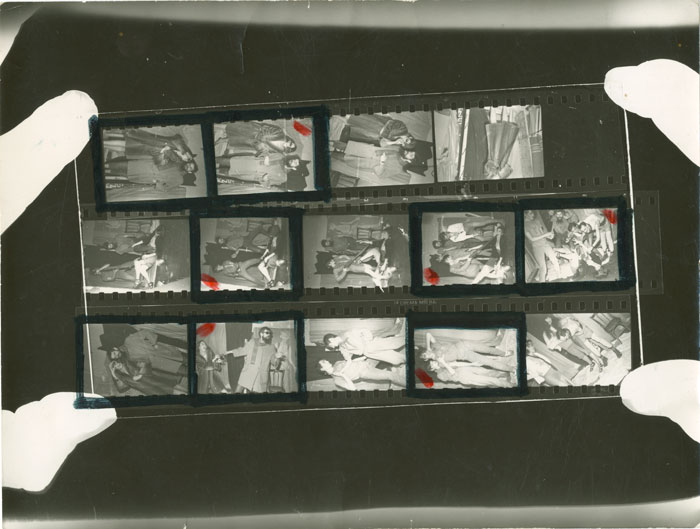
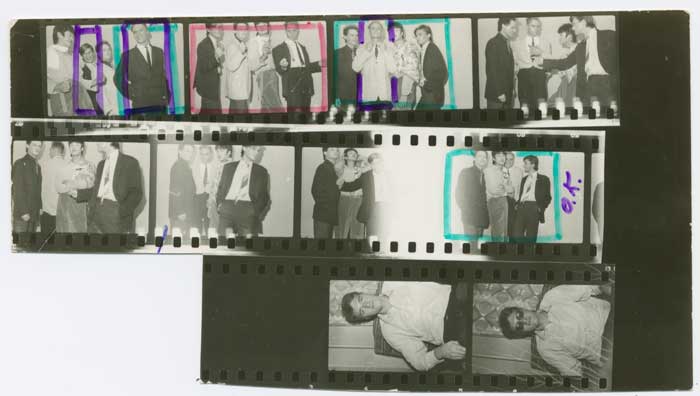
Since the exhibition E-E. Cult Heroes of the 1980s put the main focus on Kozlov’s contact sheets, I will shortly explain how these contact sheets stimulated me to carry out research into this important period of the Soviet Union's alternative or underground culture, and how, over the course of twenty years, I have been extending my activity to other archives, too.
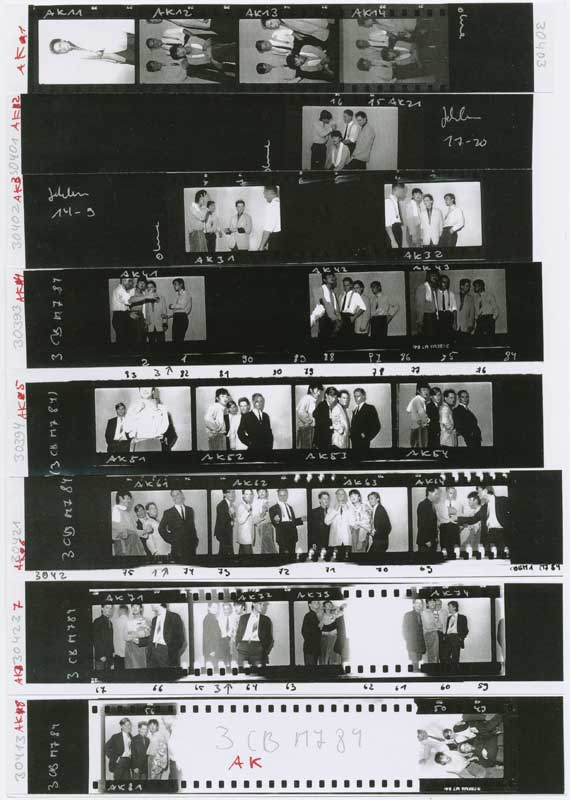
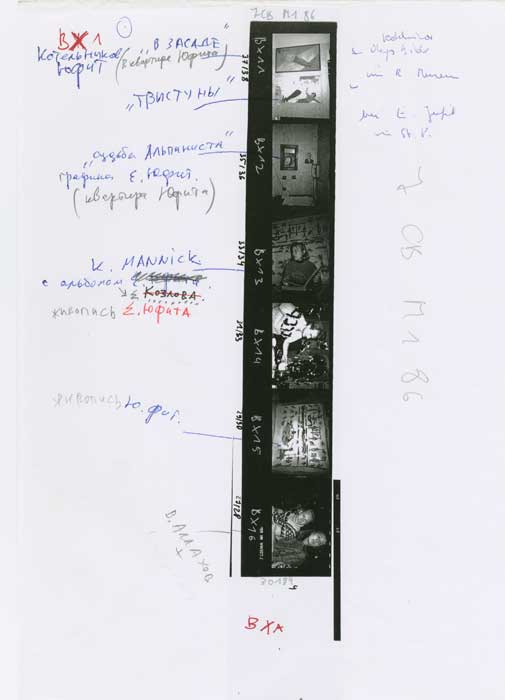
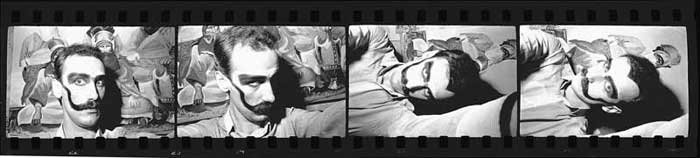
Kozlov developed the negative films – 35 mm black and white films with thirty-six to thirty-eight exposures – in his own laboratory, a small closet attached to his room. He then produced contact prints on photo paper of an 18 x 24 cm format, large enough for five strips with six pictures each – thirty pictures in total, that is, that is, a fraction of a complete film. Many contact sheets actually display less than thirty pictures, for instance just three strips with four of five pictures each. The length of a particular filmstrip obviously depends on how Kozlov would cut a film after processing it. Very often, Kozlov put together strips from several films on a single contact sheet, which shows that he did not intent to follow the logical structure of an archive. From those contact sheets he would select single pictures for vintage prints in a 15 x 10 cm format or larger, many of which are still in his own collection, but also in the collection of his friends, for instance in Timur Novikov’s Family Collection. Kozlov often gave such prints away unsigned, and they sometimes appear in books and catalogues without the name of the author. (Addendum 2025: Many of Kozlov's vintage prints are now in the collections of the Garage Museum of Contemporary Art External link >> and Davis Center for Russian and Eurasian Studies Special Collection, Harvard University External link >>.) In the second half of the 1990s, after Evgenij Kozlov settled in Berlin, we moved his works and archive to his new studio "Russkoee Polee no 2” more >>, more >>. I then had a closer look at the contact sheets and noticed that in most cases, the corresponding film strips were still attached to them, while in some other cases, only the contact prints have been preserved and the negatives are lost. On the other hand, there are also a number of filmstrips without any contacts sheets. I decided to (re-)print all negative film strips on contact sheets. In case “old” contact sheets still existed, I kept the original arrangement of the negative strips. Following this, I made Xerox copies of the new contact sheets as well as of the old "stripless" contact sheets. Whenever necessary, I cut and rearranged the xeroxed filmstrips according to their original sequence, placing and fixing them to A4 paper. It turned out to be an intricate puzzle, and in the following years, several the strips had to change places. While some films could be reconstructed with all pictures, the majority of films have missing parts at the beginning, at the end or in between. A number of strips – or even single pictures – cannot be connected to any other film.
The pages with the rearranged filmstrips allowed me to get a first impression of those places and events the pictures document. From a total of approximately 6000 pictures, 2200 are directly related to the Leningrad / St. Petersburg art scene. Because Soviet films applied various systems of frame numbering – in fact, some carry no printed frame numbers at all – I developed a single nomenclature for all pictures, so that each now has its own “name” consisting of two letters followed by two digits. (Addendum 2025: For a detailed description of the various stages of reconstructing the archive and providing it a new nomenclature see my article form 2021: Reconstructing E-E KOZLOV's photo archive from the 1980s more >>) I keep these “copied strip” pages in two big folders and mainly work with those rather than with the contact sheets or negatives, which are in another five folders more >>. A second nomenclature connects these pages to the original material.
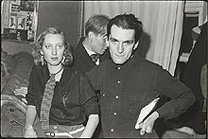
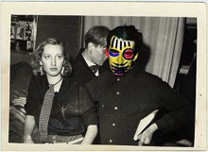
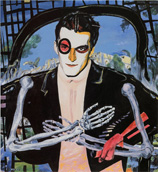
I also use a digital archive, but writing notes directly onto the paper pages has greatly helped me to contextualise Kozlov’s vintage prints and to follow the metamorphosis of an image from a photo to a painting. Kozlov’s emblematic “Portrait of Timur Novikov with Arms Consisting of Bones” from 1988 (The Russian Museum, St. Petersburg) is a perfect example of a process of selecting and transforming an image through several stages. In this case there are four stages: a vintage print, a painted vintage print, a work on paper and a painting.
To be precise, this four-stage process should be regarded as a five-stage process, because it started with taking a particular picture: Evgenij Kozlov “… did not simply fix specific gestures, glances and postures that interested him, but also provoked them by his presence with the camera.” more >> This was undeniably the case with Timur Novikov in E-E-pho-BD34. (For Kozlov's general appraoch to metamorphose images see Hannelore Fobo. E-E KOZLOV The Atlas of Ontology, 2021 more >>) When I began my research, my idea was, however, to also use these contact sheets for an analysis of exhibitions, concerts, and other events documented in these films. The exhibition E-E. Cult Heroes of the 1980s in the summer of 2000 marked the beginning of these activities, when I asked Igor Khadikov to help me to describe several New Artists performances and happenings from 1984/1985. Among the first articles were "Timur on Horseback" more >> "Good Evening Gustav " more >> "Anna Karenina" more >> "The Ballet of the Three Inseparable Ones" more >>, Pop Mekhanika 1986, “Dialogues.” (Чекасин против «Шизгары») more >>, and "Fashion Show at «ASSA Gallery»" more >>. To no little degree, E-E Kozlov's photos shape the image of the New Artists as a group of individuals staging happenings of various kinds. Later, it turned out that in most cases, Kozlov was the only one to document these events – today, they would have been completely forgotten if it wasn't for his pictures. Our articles first appeared in Russian in the St. Petersburg magazine “Na Dne” in 2001/2002. I published them online later, creating a special section at Kozlov’s website called “Leningrad 80s”. It now hosts almost one hundred articles. (Addendum 2025: now about 120 articles.) The exhibition The Raw, the Cooked, the Packaged. The Archives of Perestroika Art (KIASMA, Helsinki, 2007 more >>) gave me the opportunity to present Kozlov's principle of image selection and transformation with a number of exhibits, including the negative film more >> and the contact print more >> of "Timur on Horseback", the so-called AR series or AR film more >>.
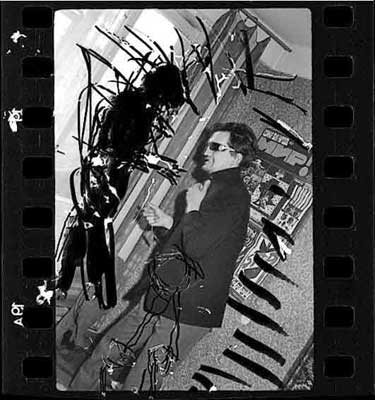
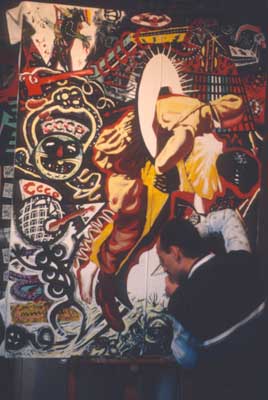
The AR film is particularly important in two respects. On the one hand, it is a perfect example of the transformation of images at an early stage, when, processing the film, “the artist scratched hatches in the still wet emulsion of the selected negatives with a scalpel and a sharp pencil” more >>. Of a total of thirty-three negatives, twenty-five display such scratching patterns of even figures, some constituting quite elaborate drawings. Consequently, these hatches appear as black lines in the contact print which, in this way, represents the second stage of a creative process (first stage: selecting / creating the motif for the picture; second stage: selecting and transforming a picture with scratching; third stage: printing the contact sheet). On the other hand, the AR film is also significant with respect to the number of works derived from it – painted collages, drawings on paper and paintings, fourteen all in all. Among the paintings is the emblematic "Timur on Horseback", the title of which I used to designate the series. "Timur on Horseback", based on AR42, was shown on stage during Sergey Kuryokhin's legendary Pop Mekahnika concert with DJ Westbam in Riga, 1987 more >>. It was printed on the catalogue cover of the first large international exhibition of the New Artists, "De Nya från Leningrad", Kulturhuset, Stockholm, 1988 more >>, and was the logotype for The Raw, the Cooked, the Packaged. The Archives of Perestroika Art more >>. Unfortunaley, the whereabouts of this painting are unknown. The same goes for another large painting, Страх Врагам / Terror to the enemy, based on AR44 more >>, while "When You Start Feeling Muscles", related to AR11 and a number of other pictures, is now in the collection of the Russian Museum, Saint Petersburg more >>. In the following years, (E-E) Evgenij Kozlov’s exhibitions, New Artists retrospectives, as well as several book releases, such as "Владислав Мамышев-Монрo в воспоминаниях современников / Vladislav Mamyshev-Monroe in the Memories of his Contemporaries" (2016) more >> inspired me to write a number of new articles. High-resolution scans of the negatives have helped me to determine facts, for instance the display of artists’ collages during the performance “The Ballet of the Three Inseparable Ones” more >>. The result of digitalizing a 35 mm negative in high resolution is actually quite impressive – even in comparison to the resolution of modern digital photography, unless we compare it to the image quality obtained with a full-format digital camera. Yet, as always, new technologies have their own shortcomings: high resolution scanners for negatives cut the images close to the film perforation, which reduces their visible surface. In the case of Kozlov’s films, images may well extend into the perforation, and the same goes for his scratching techniques applied to the moist emulsion of the films. Contact sheets are therefore still indispensable to capture some features along the images’ borders.
Since 2014, I have considerably intensified my research, and its subject matter has extended to the early 1990s, based on E-E Kozlov’s videos and my own pictures. A number of publications are based on conference papers or lectures, for instance my lecture at the Institute of Advanced Studies, University College London in 2018 – Popular Mechanics 'Insect Culture' and 'Stiob' more >> (Video recordings of lectures are also available on Kozlov’s YouTube Channel external link). Insect Culture, the LP released by Ark Records, Liverpool, in 1987, has one of Kozlov’s pictures of Sergey Kuryokhin and New Composers Valery Alakhov and Igor Verichev on the album cover more >>. (Addendum 2025: painted versions of two pictures from the Insect Culture photo shoot were recently identified in The Pete Fulwell archive at Liverpool John Moores University more >>.) Although Kozlov’s archive of pictures is indeed very vast, it clearly does not cover all aspects of my research. Other photographers have made substantial contributions, generously pemitting me to use and publish their pictures. Andrey Boyko gave me rare colour reproductions of Evgenij Kozlov's early works more >>. Hans Kumpf shared with me his photo-archive of his travels to the Soviet Union and performances with Sergey Kuryokhin, which triggered off a whole series of articles on Pop-Mekhanika concerts more >>. Reconstruction of New Artists exhibitions would not have been possible without pictures from the archives of Peter Sylveire (London, 1988 more >>), Brian Biggs (Liverpool, 1989 more >>), Fredrik Vogel (Stockholm, 1988 more >>), Enno de Kroon (Rotterdam, 1988 more >>) and Alexander Savatyugin (Leningrad, 1988 more >>). Documents I received from Sergey Chubraev, Andrey Klobystin, Masha Savelyeva-Novikova, and many others greatly helped me to advance my research. Their names are mentioned in the respective articles, as well as the names of those who helped me identifying people and places. Saint Petersburg art historian and curator Ekaterina Andreeva allowed me to publish some of her own articles on our website more >>, and American rock singer and author Joanna Stingray provided me with two chapters from her autobiography on her “Russian years” more >>. Her book Стингрей в стране чудес / Stingray in Wonderland, co-authored with her daughter Madison Stingray, was released in Russia in 2019. "Red Wave", an English version, was published in the US in 2020 more >>. Last but not least, the online archive of RAAN, the Russian Art Archive Network, has become an increasingly important source for studies on that significant period of late-Soviet underground culture. External link >> Given the fact that the Leningrad art scene is little known outside Saint-Petersburg and Russia, my aim has been to describe and contextualise these primary sources as precisely and comprehensively as possible so that other researchers can refer to them for their publications on the subject matter. Publishing my findings on E-E Kozlov’s website allows me to not only make ample use of illustrations, but to set internal and external links, the way Wikipedia authors do. In many cases I carried out original scientific research – or, perhaps, the term “fundamental research” would apply better. Thus, I have been the first to entirely or partially reconstruct important New Artists exhibitions (to date, a total of eight) and to provide a detailed assessment of Sergey Kuryokhin’s relation to right-wing ideologue Alexander Dugin, with my article from 2018/2020 Empire and Magic. Sergey Kuryokhin's “Pop-Mekhanika No. 418” (1995) more >. It also turns out that a number of New Artists activities would have gone unnoticed or be forgotten today if it wasn't for E-E Kozlov's pictures. Focal points of my research are
– New Artists exhibitions and performances at home and abroad, and, analysing them, a periodisation of the history of the New Artists (taking into account Timur Novikov’s artists lists more >) – Vladislav Mamyshev-Monroe’s emergence as an artist (1989-1991) more > – Sergey Kuryokhin and Pop Mekhanika more >. Publications are in English unless the text was originally written (or the lecture originally given) in German or Russian. However, as my native language is German and I have spent most of my life in Germany, using English as a foreign language imposes a number of limitations on my writing, not only with regard to the speed of writing, but also because only a few of my articles were proofread by native speakers. I must therefore apologise for any errors in syntax and grammar that have escaped my attention. Finally, I cannot help but refer to a truism: contextualising archival artefacts is an ongoing process, and it seldom leads to completely satisfactory results. Many assumptions can never be verified for lack of documentation – or for lack of time it would take to pursue a lead. On the other hand, later findings may force us to correct what we have already accepted as factual, especially with regard to a specific succession of events. Whenever such contradictions turn up, I try to consider them in my earlier articles, but some contradictions between two or more descriptions might still exist. Hannelore Fobo, 2020 (revised 2025) |
||||||||||||||||||||||||||||||||||||
| Uploaded 14 April 2025
Last updated 18 April 2025 |
||||||||||||||||||||||||||||||||||||
|
home // E-E // biographie // art // eros // Leningrad 80s // Valentin Kozlov // 2 x 3m // events // lageplan // kontakt /
|